Account · For the quality manager
The Standard Map
Standards scope and the Standard Map: read the standard map; record a control decision. This is part of chapter 8 of the NormaQMS User Guide.
Read the Standard Map
Open: Settings > Standard map, or the standard-edition link in the sidebar.
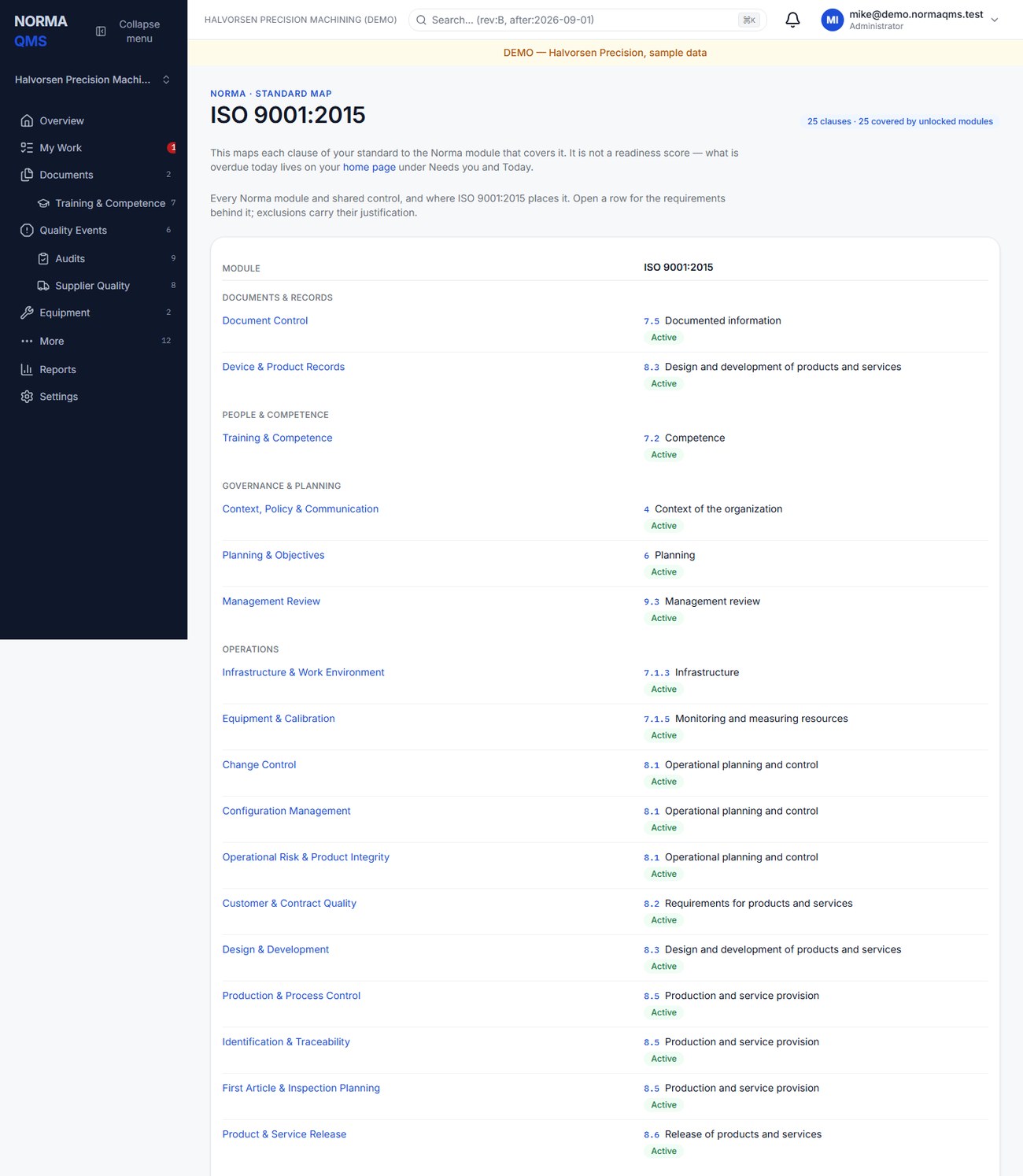
Rows show modules and shared controls. Columns show adopted standard editions. A cell identifies the corresponding clause and whether the module is active, locked, or otherwise represented. Expand a module row to see its requirements, readiness signals, and shared-control relationships.
Use the edition controls to compare standards. At least one edition remains visible. Scope and as-of-date filters, when used in the page address, narrow the map without changing the organization's subscriptions or baselines. Bookmark the filtered map if you use it for a particular review.
Not applicable (your decision) identifies a scope decision. A Plan gap identifies an adopted edition whose overlay is not included on the plan. Readiness signals summarize available records; they are not certification scores. Different scopes can have different applicability decisions, and the map names the scope when that distinction matters.
Shared controls show how one operating control supports requirements in more than one standard. Use this view to avoid creating three duplicate procedures merely because three standards describe the same activity differently.
A control's name on the map opens that control's own page (below).
Record a control decision
Open: select a control's name on the Standard Map. A control is one way of satisfying an obligation, shown once across every standard you hold. Its page lists, for each adopted edition, the requirements the control answers, any obligation that edition adds separately under Additional in this standard, and the assessment evidence gathered against each. Evidence carries between standards only where the registers say the obligation is the same; where one standard states it more strictly, or adds a separate obligation, the page says so and that obligation needs its own evidence.
- Under Your decision, choose the Disposition: Adopted, Not applicable, or Planned.
- Write Why (an auditor reads this). The rationale is required.
- Optionally choose an Owner from the functional roles.
- Choose Record decision.
Only a quality manager or administrator records the decision; a consultant key cannot state it for you. A control decision is your shop's own position on that control. It does not change a scope baseline, its applicability decisions, or any readiness signal; record a requirement-level exclusion in the scope as described above. A Provisional pill means a standard's register has not been reviewed row by row, so what the control claims about that standard is not confirmed.
In the user guide
This article is part of chapter 8, "Standards scope and the Standard Map", of the NormaQMS User Guide (NORMA-UG-001), which is under Help > User guide. Chapter numbers in the text refer to that guide. The same chapter also covers: Create or revise a QMS scope; Applicability is a controlled decision; Plan the ISO 9001:2026 transition.